Your accounts
Personalcfpperche@gmail.com · Google
Companycarlos@cognix.se · provider to confirm
A company address stays private unless you explicitly grant access. Other supported accounts can be added later.
Personal mail, company mail and agent decisions, with one place to work and clear control over every account.
The Inbox stays a first-class COGNIX[WS] surface. Official extensions connect Gmail, Microsoft and other providers through a versioned mail contract.
You connect an account once. Seeing mail yourself and letting an agent use it are separate decisions.
Needs you retains its own queue and badge. Incoming mail cannot bury a blocking approval.
Every conversation has an origin. Replies use the receiving account; changing From is explicit.
Account access is off by default. Drafting and approved sending have separate grants.
A company address stays private unless you explicitly grant access. Other supported accounts can be added later.
| Option | Benefit | Trade-off |
|---|---|---|
| Everything in core | Less initial adapter protocol work. | Every provider adds core maintenance and release coupling. |
| Everything in an extension | Independent package and optional installation. | A separate app fragments the Inbox; deep integration still needs core doors. |
| Hybrid Recommended | One native Inbox, optional providers and central controls. | Upfront work on mail, authorization and operation contracts. |
Connect accounts, read and write mail, choose agent access and approve exact outgoing messages.
Use only granted accounts, summarize selected messages, prepare drafts and propose work or sends.
Keep identities separate, reconcile provider state, preserve drafts and expose failures honestly.
Extend the platform at explicit doors. Provider packages do not inject arbitrary components into the host interface.
Native desktop, browser and phone experience
Accounts · threads · messages · drafts · operations · grants
Host authorization · refresh · revocation · approval · receipts
Gmail + Workspace
Microsoft 365 + Outlook
IMAP + SMTP, later
| Existing platform support | What mail still needs |
|---|---|
| Core Inbox, conversation navigation and event feed. | A mail model with account/provider identities and email actions. |
| Supervised extension processes, instance activation, private databases, reviewed manifests. | A provider declaration, account lifecycle, mail sync contract and operation receipts. |
| Calendar provider extension doors. | A mail door with a separate contract; email is not an FYI item. |
| Assistant-owned OAuth connections. | Person-owned service connections with distinct grants; no automatic credential sharing. |
Use separate mail tables for accounts, threads, messages, drafts, operations and grants. Do not stretch inbox_items into a MIME store.
Account + external conversation + external message form the identity boundary. Equal subjects across accounts never imply equal conversations.
Keep owner drafts and operation records durable in the core. Adapter cursors and reproducible provider cache stay separate. Store mutations announce their events transactionally.
The host owns authorization, refresh and revocation. Adapters use reviewed, constrained authenticated operations, with pinned origins, methods and resources; this is not an arbitrary HTTP proxy.
This generalizes the existing Assistant-specific OAuth boundary and needs an ADR. It is proposed work, not an existing extension capability.
Extension processes run as the operating-system user. Reviewed permissions are a consent contract; they do not create OS process isolation.
| Condition | Action |
|---|---|
| New account | Import a bounded recent window, then continue with incremental synchronization. |
| Gmail history expires / provider cursor is invalid | Resynchronize the configured window without duplicating messages. |
| Message changed in Gmail or Outlook | Reconcile read/archive state; preserve an open local draft. |
| Send response is lost | Mark uncertain and reconcile. Never blindly resend. |
| Grant revoked / account disconnected | Refuse new scoped operations, reconcile any already dispatched action, retain drafts. |
| Backup restored | Restore declared user data. Reconnect missing credentials. Restored operations never auto-send. |
| Extension removed | Explain affected accounts; keep user drafts/history by default. Deletion is an explicit choice. |
Email HTML is untrusted: isolate rendering, block scripts and control remote images. Attachments are not executed. Received text cannot authorize tools.
Agent access is per account and principal. Sending mail to a model is a separate data flow that must be disclosed and checked against the provider's data policy.
Declare mail records, attachments and drafts in the persistence inventory. Add independent recovery fixtures for current and older snapshots.
Existing extension and Assistant secret stores have explicit backup exclusions. Mail cannot promise portable sign-in recovery without an approved change to that policy.
Approve architecture boundaries, wireframes, account grants, operation states and backup behavior. Record the core/extension and OAuth changes in an ADR.
Exit: reviewable contract + decision table + desktop and phone states.Connect multiple accounts, import recent threads, read and search, resume sync and reconnect.
Exit: real-provider read/sync evidence; no claim of a complete mail client yet.Compose, reply, reply all, forward, attachments, drafts, read/archive synchronization and the actual provider of carlos@cognix.se.
Exit: both requested accounts complete the read → reply → provider reconciliation loop.Explicit account grants, bounded reading, draft proposals, immutable send reviews and optional conversion to a mission.
Exit: unauthorized reads refused; changed messages invalidate prior send approval.Add providers by demand, IMAP/SMTP coverage and push notifications where the deployment supports them.
Exit: every adapter passes the shared provider contract.Gmail read-only and modify scopes are restricted. A personal pilot and public distribution have different verification conditions. Determine verification and any assessment requirement from the actual deployment and data flow, including model access.
Use read-only for a reading pilot. A full read/archive/reply experience needs an appropriately broader reviewed scope; application grants must still restrict what each agent can do.
Each implementation branch follows the repository's isolated-worktree, documentation, scoped-check and closing workflow. Integration and deployment remain separate authorized steps.
The three Dribbble artworks below were opened in the conversation browser and inspected visually. They inform layout and hierarchy; they do not prove connection or synchronization behavior.
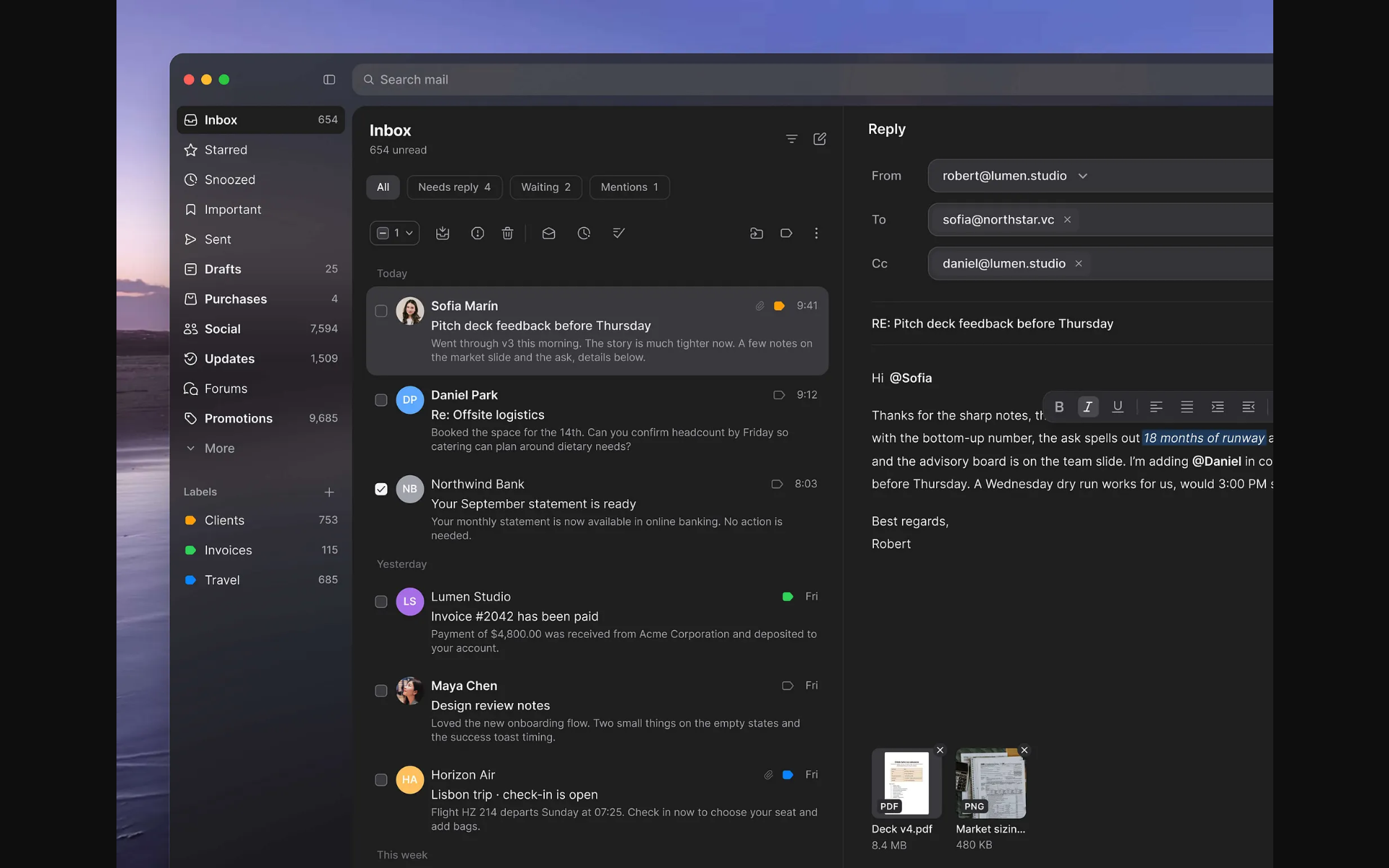
Adopt the list-to-reply continuity, explicit From selector and attachment tiles. Avoid decorative translucent window chrome.
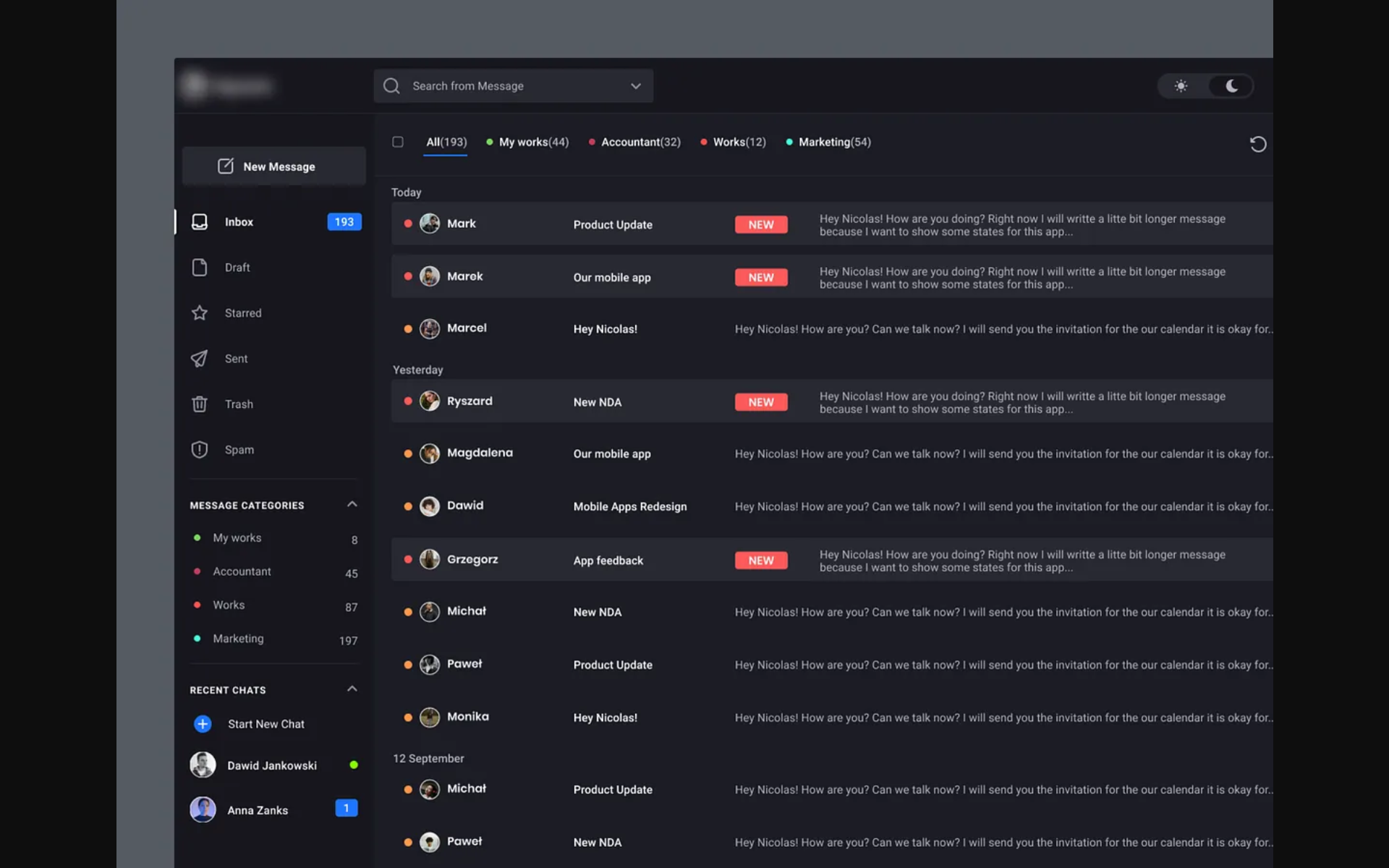
Adopt sender/subject hierarchy and muted previews. Avoid repeated bright NEW badges and a second chat section.
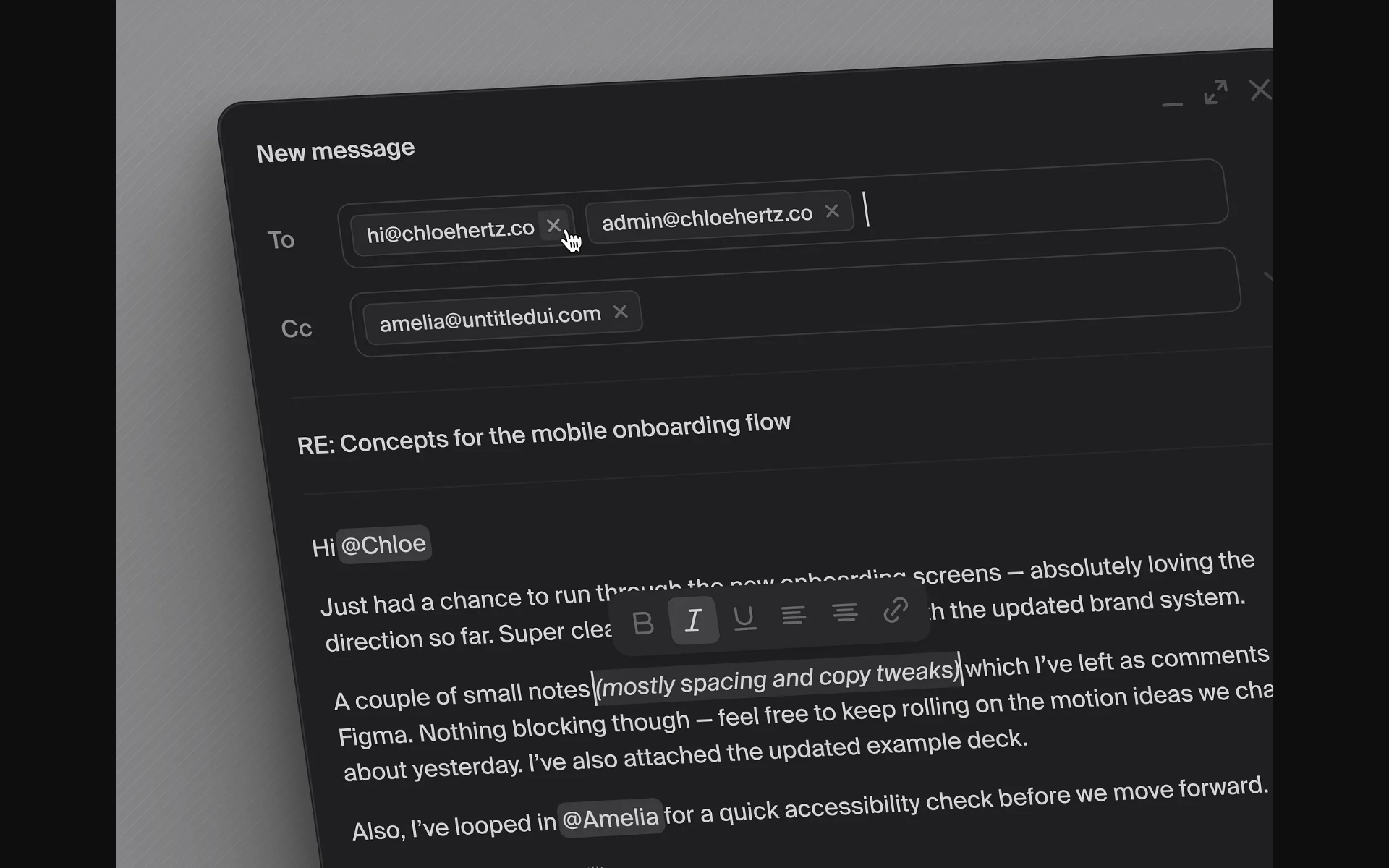
Adopt recipient chips and subject/body separation. Add explicit account identity and visible Send; those states are absent from the artwork.
docs/architecture/inbox.md · extensions.md · assistant.md · backups.md · ADR-0208, ADR-0221, ADR-0230, ADR-0324 · internal/server/extensions_host.go · internal/store/inbox.go · internal/backup/inventory.json
Visual foundation: the canonical web/shared/tokens/theme.css, the existing Inbox study and the repository's Cursor adaptation for compact, keyboard-accessible controls.